


UZ Fabric×Odaikano
Collaboration
A special collaboration inspired by Kabuki has begun between UZ Fabric and Daidaikano! The theme of the first collection is "KABUKU." A special collaboration has been realized between UZ Fabric and Daidaikano, a modern art project created by Kabuki actor Hashigo Nakamura based on a sensibility rooted in Japanese culture. Items inspired by Japanese beauty and tradition will be released.
Daidaikanou
Kabuki actor Hashigo Nakamura is creating a modern art project inspired by his Japanese sensibility. His creations range from "expression" to "products."

This is the artist name of kabuki actor Nakamura Hashigo, whose theme is to make everything "possible" and "come true" without being bound by conventional wisdom. While performing as a kabuki actor in theaters both in Japan and abroad, he also works on modern art and product design, utilizing his inherent sensibilities rooted in Japanese culture, and has collaborated with various companies. His "creative kabuki" by "kabuki actors who take on contemporary social issues," which address social issues such as the global environment and world peace, has attracted much attention as an art performance.
Nakamura Hashigo Official Instagram
@nakamura_hashigo
Collaboration Item
-

Half-width bag | Koushi_L01 -

Half-width bag | Dankanoko_R01 -

Half-width bag | Asanoha_R02 -

Half-width bag | Asanoha_R01 -

Half-width bag | Asanoha_R03 -

Half-width bag | Asanoha_R06
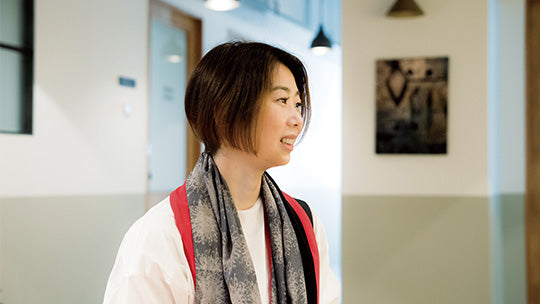
Nakamura Hashigo (Kabuki actor, Ooda Kana) x Koderazawa Yuko (Representative of UZ Fabric)
Special Dialogue: Inheritance and Evolution of Traditional Culture
Nakamura Hashigo is active in the world of Kabuki, a form of traditional Japanese performing arts. In order to spread the appeal of Kabuki to as many people as possible, he is a young revolutionary who not only performs on stage but also engages in a variety of expressive activities that transcend genres and formats. UZ Fabric, which approaches vintage kimonos from a new perspective as textile art, proposes innovative products. The "KABUKU" collection was released as a fusion of each artist's unique thoughts and ideas about "Japanese culture," "Kabuki," and "Kimono." What are the thoughts behind the products, and what do the two artists think about the "future of Japanese culture"?
UZ Fabric made me realize the common sense of Kabuki actors and the beauty of the kimonos we see every day.

Koderazawa: When I first started UZ Fabric, I was conscious of using kimono (as a material), but not making it too Japanese, or too "wa" (Japanese for short). My first priority was to give new life to the beautiful kimono patterns as textiles in a new form. However, in recent years, the number of overseas customers has increased dramatically, and I was thinking that by incorporating the cultural aspects and meanings of kimono as an essence, which I had consciously avoided until now, I might be able to get more people to empathize with the philosophy of this brand. Just at that time, I was able to work with Hashigo. Despite being in the world of Kabuki, which is a traditional Japanese art, he has made many efforts to convey Japanese culture in new ways. I thought that with Hashigo, we could create something that would exude Japanese culture in a new, modern way without being too "wa" (Japanese for short).

Nakamura : "In the world of Kabuki, kimonos are also treasured. They are used carefully for 10, 20 years, even decades. There are craftsmen called costume designers who look after kimonos. Thanks to the care they provide, kimonos remain in such good condition even today. This is a problem that exists in our industry as well -- there is an inevitable difference between modern and old kimonos. This doesn't mean that modern kimonos are bad, but it just means that the techniques of the past were truly incredible. I think that the strength of the hand-made, craftsmanship aspect is evident in old kimonos. Even when you pick up a scrap of fabric, there are many that make you wonder, 'Who came up with this pattern?' or 'Who made this fabric?' The products I made this time with UZ Fabric are decorated with patterns such as dankanoko, hemp leaves, and 16-musashi. Among these are things that are common knowledge for us Kabuki actors, things that we learn and see on a daily basis -- and it was UZ Fabric that made me realize once again how wonderful such things are."
People often talk about the "tradition of Kabuki," but I believe that tradition is born from repeated innovation.

Nakamura : For example, there is a pattern called "clenched teeth," which is actually often used on various things such as tenugui towels. The pattern was originally based on the kumadori (make-up) motif, but even if you turn it upside down, it still looks like the same image of clenched teeth. I think that such patterns can be seen as both a traditional pattern and a form of modern art. What I'm trying to say is that, although we often hear about the "tradition of Kabuki," it is precisely through repeated innovation that tradition is born.

I've loved fashion since I was young. I was exposed to street fashion and domestic brands. I shopped at STUSSY, Supreme, and Ura-Harajuku. I went to second-hand clothing stores and learned how to appraise vintage jeans. I was interested in and loved these things at a very impressionable age. And I was also drawn to Kabuki in the same way. I thought it was amazing. I don't just want to convey the things that I find amazing and interesting, I want to create them. It's difficult to say what I want to create specifically, but as a feeling, it's something called "Kabuki" that I have incorporated into myself. I think it's the coolest thing.

Among Kabuki costumes, there are many that make me think, 'This is really great,' or 'It's old-fashioned but cool.' I imagine that if I add a few more modern elements to these, it might create a whole new kind of fun, and so I'm giving shape to these fantasies one by one. I'm not a designer, but I'm always thinking that if I combine what I think is great about Kabuki with the cool Kabuki that exists in the world today, something even more amazing might be born."
Speed is key. The most important thing about this project was to quickly give shape to the parts that resonated with Hashigo.

Koderazawa: "At first, it was just a feeling of, 'It'd be great if we could do something together.' We didn't have any particular ideas in mind. But, since we had the opportunity to work together, I wanted to get started as soon as possible (laughs). A sense of speed, I guess. Hashigo is a very busy person, so I thought that if we didn't start right away, a year or two would pass by in the blink of an eye. So I thought the best thing to do would be to quickly give shape to the parts that resonated with us. So, my initial idea was that we should just tweak an existing product.

This half-width bag is one of UZ Fabric's most popular products, and I thought it would be good to use it as a base and add some ideas to it. At that time, Hashigo told me about Kabuki costumes - patterns, fabrics, and designs. He said that each performance has its own distinctive costume. So I thought it would be great to take that essence and incorporate it into something."
Nakamura : (Seeing the real thing) It's the best, really.
Koderazawa: "I think it's turned out pretty well (laughs)."
Nakamura : "I had heard about the concept for a long time and had received image photos, but seeing it in person was just so cute."

Koderazawa : "Recreating the costumes was difficult. For example, even with the Benkei motif, I was looking for fabric with black and white checks. For the hemp leaf pattern, I tried to find fabric with a similar color as possible, but I realized that this would be difficult. So I decided to just lay the pattern on top."
Nakamura : "No, this is a good feeling. Rather than something that's exactly the same, I think you can see the direction of what they're trying to do and what they want to do. It's really impressive."
We must never forget to respect the sensibilities and techniques of our predecessors. This is reflected in the stories and characters of Kabuki.

Nakamura : "I think that we who live in the present day should have more respect for the sensibilities, inspiration, and techniques of people from the past. This is reflected in the stories and characters of Kabuki. The Japan of the time when it was created is present in the designs and stories. You could even say that it remains in the performing art of Kabuki."
Koderazawa : "From the perspective of kimono, the designs and patterns of the past were only possible thanks to the skills of artisans. As time passes, such skills and techniques are inevitably lost. The number of artisans is decreasing rapidly, and it is becoming increasingly difficult to pass on these techniques. This is a real shame. However, I believe that we can and should make use of them."

Nakamura : "The birth of something new is not a bad thing at all. After all, it means that the story will continue into future generations. When customers see these three works, they may feel something deep, or they may think, 'It's really wonderful,' or 'I'll go see the play.' Each person should be able to perceive the story in their own way. What is expressed in these bags is the lingering scent of the good old days of Japan, an era that we cannot experience in real life, and a respect for that. Innovation and tradition are firmly connected. I think that is the most important thing."
I believe that "culture" is the process of inheriting the feelings that go into the fabric and patterns of kimonos while evolving into something new.

Koderazawa : "Kimonos are a bit of a challenge to wear, and in this day and age, there are very few opportunities to wear them. Perhaps only on weddings, funerals, and other ceremonial occasions. I think that's how few opportunities there are to come into contact with kimonos. In order to preserve kimonos even in these times, we must first increase the opportunities for people to come into contact with them. UZ Fabric is doing a variety of things to achieve this. We want to create an opportunity for people to encounter the culture of kimonos by wearing them with a modern sensibility, rather than just keeping old items as they were in the past. We want to faithfully inherit the essence and feelings that are embodied in the fabrics and patterns of old kimonos, while the shapes are constantly evolving into new ones -- I personally believe that this is what 'culture' is."

Nakamura : "That's absolutely true. Preserving tradition is easy, but if you do it the wrong way, you won't be able to preserve it. I think what's absolutely necessary is respect. All you need is that feeling. What's common is to pass it by without seeing what's inside it. The important thing is whether you can properly notice it. I think it's connected to everything, whether it's a story, a technique, or a person. When you stop and think carefully, something in your heart leaps. That's the kind of sensibility that we want to cherish."
Interview, text: Masako Karasawa
Collaboration Item
-
Half-width bag | Koushi_L01 -
Half-width bag | Dankanoko_R01 -
Half-width bag | Asanoha_R02 -
Half-width bag | Asanoha_R01 -
Half-width bag | Asanoha_R03 -
Half-width bag | Asanoha_R06
Event Information
EASE (located in Shinagawa Ward, Tokyo), which operates photography studios, photography prop rentals, spatial displays, etc., will be holding the 6th Ethical Christmas Market, "Meguro Street Corner Heart & Art Christmas," at Meguro STUDIO EASE in Tokyo from Friday, December 6th to Sunday, December 8th, 2024, in order to further revitalize the area around Meguro Station and improve the image of the station front.